Multiplication becomes much easier when children begin to notice patterns instead of seeing every fact as something completely separate to memorize.
That is one of the most important ideas in multiplication learning: children build fluency faster when they can spot structure, use known facts to figure out unknown ones, and understand how multiplication works visually and numerically. Research and instructional guidance both support this approach. (NCTM)
Why patterns matter in multiplication
Many children are first taught multiplication as a list of facts to memorize. But strong multiplication learning usually develops in stages:
- children notice repeated groups
- they learn skip-counting and equal-group patterns
- they use properties like commutativity and distributivity
- over time, these patterns support faster recall
This matters because not all multiplication facts are equally hard. Research shows a problem-size effect: facts with larger numbers are generally slower and more error-prone than facts with smaller numbers. Researchers also describe a five effect and a tie effect, meaning that facts involving 5 and square facts like 6 × 6 are often easier than nearby facts. (Frontiers)
Pattern 1: Skip-counting patterns
The first multiplication patterns many children notice are skip-counting patterns:
- 2s: 2, 4, 6, 8, 10...
- 5s: 5, 10, 15, 20...
- 10s: 10, 20, 30, 40...
These are useful because they connect multiplication to skills children often learn earlier, especially counting by equal intervals. That helps explain why facts involving 2, 5, and 10 are usually easier than facts involving 7 or 8. (Frontiers)
Skip-counting is a great starting point, but it is not the whole story. Children also need to move beyond counting and begin seeing multiplication as groups, arrays, and relationships between facts. (NCTM)
Pattern 2: Turn-around facts
One of the most powerful multiplication patterns is the commutative property:
- 3 × 7 = 7 × 3
- 4 × 6 = 6 × 4
- 8 × 5 = 5 × 8
This means children do not have to treat both versions as completely different facts. Once they know one, they can use it to solve the other. That reduces the number of facts they need to learn and helps them see multiplication as a connected system rather than a long list. NCTM guidance specifically highlights the commutative property as a core step in multiplication fluency. (NCTM)
Pattern 3: Arrays and rows-and-columns structure
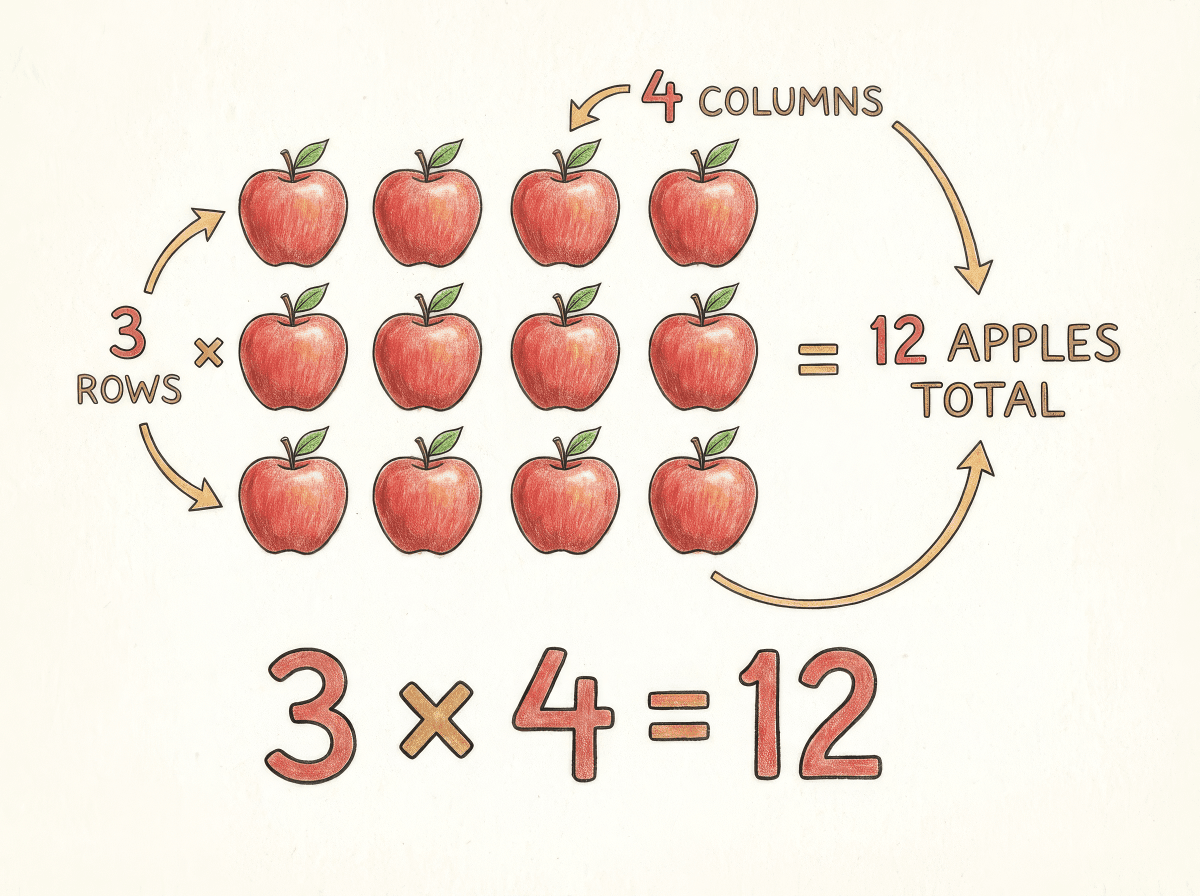
Arrays help children see multiplication:
- 3 × 4 means 3 rows of 4
- 4 × 3 means 4 rows of 3
This visual structure is one of the strongest ways to build understanding. Research and teaching guidance both point to arrays as a meaningful model for multiplication because they make equal groups, rows, columns, and turn-around facts visible. (NCTM)
Arrays are especially helpful when children stop counting one by one and begin noticing the groups. That is when multiplication starts to feel organized and predictable.
Pattern 4: Friendly facts and derived facts
Children do not need to know every hard fact immediately. They can use easier facts as stepping stones.
Examples:
- 6 × 7 = 5 × 7 + 7
- 7 × 8 = 5 × 8 + 2 × 8
- 8 × 6 = 3 × 6 + 3 × 6
This is the distributive property in action. It allows children to break harder facts into smaller facts they already know. NCTM materials specifically highlight the distributive property as a major part of multiplication understanding in the elementary grades. (NCTM)
This is one of the most useful patterns in multiplication because it helps children bridge from understanding to fluency.
Pattern 5: Square facts as anchor facts
Some multiplication facts naturally act as anchors:
- 3 × 3
- 4 × 4
- 6 × 6
- 7 × 7
Research describes a tie effect, where square facts are often easier to answer than nearby non-square facts. Once a child knows 7 × 7, that fact can help with 7 × 8 or 6 × 7. (Frontiers)
These square facts are useful because they can serve as "helper facts" for harder problems.
Pattern 6: Bigger numbers are usually harder
This pattern is not a trick, but it is one of the most important findings in multiplication research: larger facts tend to be harder.
Facts like 2 × 4 or 3 × 5 are usually easier than facts like 7 × 8 or 8 × 9. This is known as the problem-size effect, and it appears consistently in multiplication research. (Frontiers)
This helps explain why many children learn the 2s, 5s, and 10s early but need much more practice with the 6s, 7s, 8s, and 9s.
Are number tricks and chart patterns useful?
There are also many "fun" multiplication-table patterns:
- even numbers always creating even products in some cases
- repeating ones-digit cycles
- digital-root tricks
- visual symmetry in multiplication charts
These can be interesting, but they are usually less important instructionally than the big patterns children actually use to build fluency: skip-counting, commutativity, arrays, square facts, and distributive reasoning. (NCTM)
What parents and teachers should focus on first
The most useful multiplication patterns for children are:
- 2s, 5s, and 10s skip-counting patterns
- turn-around facts
- arrays and equal groups
- square facts like 6 × 6 and 7 × 7
- derived facts using known facts to solve harder ones
These patterns help children build both understanding and speed.
Why this matters for Time To Multiply
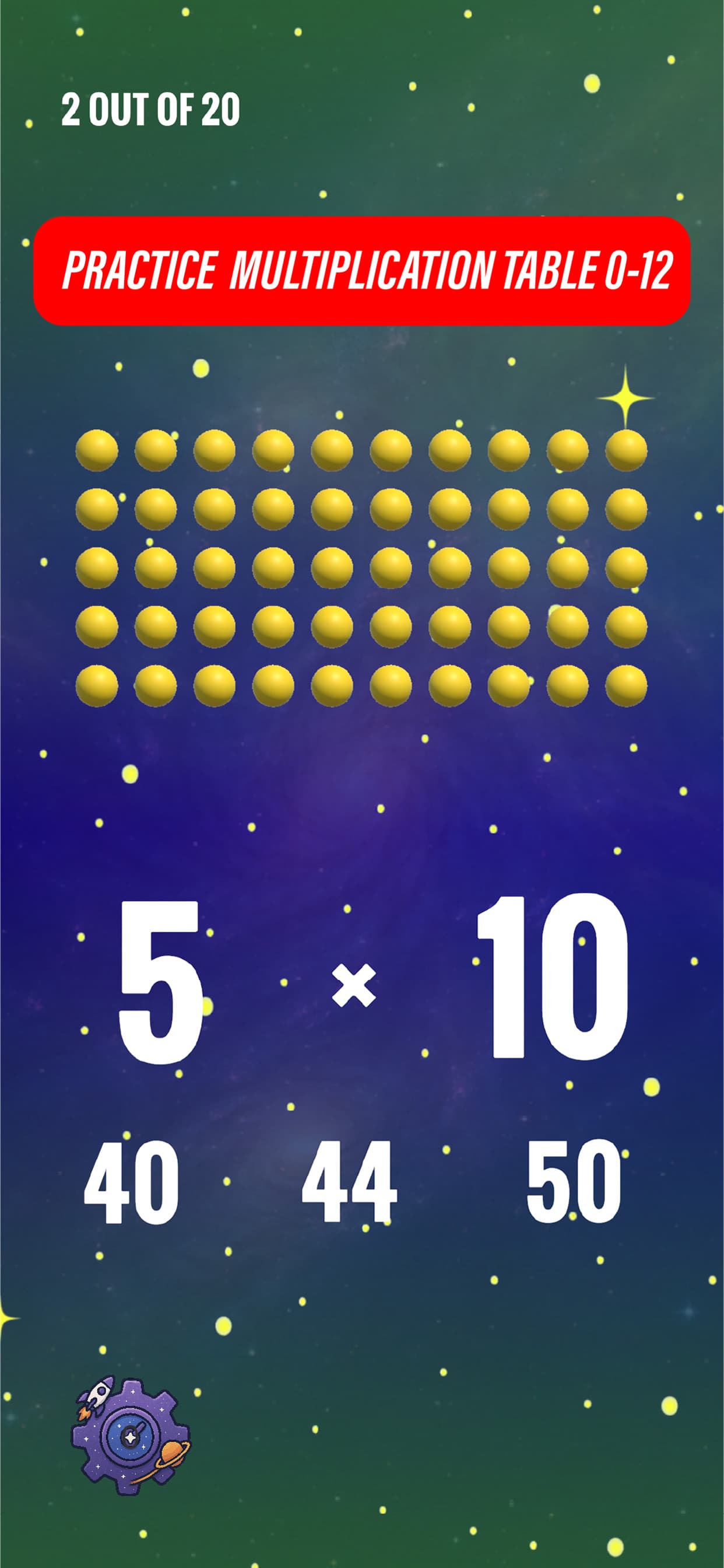
A strong multiplication app should do more than ask random facts over and over. It should help children notice structure.
That means supporting:
- easier pattern-based facts first
- repeated exposure to commutative pairs
- visual understanding through grouped structure
- harder facts through derived-fact reasoning
- extra practice on large facts that usually need more repetition
When children see multiplication as a pattern-rich system, practice becomes more meaningful and much less frustrating.
Sources
- National Council of Teachers of Mathematics (NCTM), Using Arrays for Meaningful Multiplication. Emphasizes row-column structure, arrays, and meaningful multiplication models. (NCTM)
- National Council of Teachers of Mathematics (NCTM), Three Steps to Mastering Multiplication Facts. Highlights skip counting, commutative property, and distributive property in multiplication fluency. (NCTM)
- National Council of Teachers of Mathematics (NCTM), The Distributive Property in Grade 3? Supports early use of the distributive property in multiplication understanding. (NCTM)
- NCTM, Focusing on Multiplication and Division. Discusses the commutative property and area model as central multiplication ideas. (nctm.org)
- Huber et al., On the interrelation of multiplication and division in secondary school children, Frontiers in Psychology (2013). Summarizes the problem-size effect, tie effect, and five effect. (Frontiers)
- Jay et al., Game-Based Training to Promote Arithmetic Fluency, Frontiers in Education (2019). Reviews multiplication fact networks and common effects such as problem size, five effect, and tie effect. (Frontiers)
- Prado et al., The neural bases of the multiplication problem-size effect, Frontiers in Human Neuroscience (2013). Supports the claim that larger multiplication facts are harder than smaller ones. (Frontiers)
- Van Beek et al., The arithmetic problem size effect in children, Frontiers in Human Neuroscience (2014). Extends the problem-size effect evidence to children. (Frontiers)
- Fyfe et al., Relations between patterning skill and differing aspects of early mathematics knowledge, PMC. Supports the broader connection between patterning ability and early math development. (PMC)